Summary: Corporate dental companies offer dentists relief from non-clinical tasks by taking over administrative functions like HR, insurance, and marketing. However, this often comes at the cost of losing control over key decisions and ownership. Alternatives such as doctor-owned partnerships or maintaining independent ownership allow dentists to retain leadership while receiving necessary support without fully relinquishing control.
The level of ownership significantly influences the decision-making process for a dentist considering corporate dental companies. A practice owner who wants relief from HR, insurance, legal, marketing and finance work is not always trying to stop being the leader of the practice. The cost of choosing the wrong structure is not just equity on paper, it is the day-to-day authority to make decisions for patients, staff and the future owner.
Corporate offers sound simple because they turn exhaustion into a transaction. The owner gets a path to liquidity, the buyer gets scale, and the practice gets a larger business engine behind it. The harder question is whether the dentist still gets to set the standard of care, build the team, and decide what happens next.
Our position is clear: back-office relief should not require giving up majority ownership or clinical control. Corporate dental companies are one option, but they are not the only path for dentists who want growth, liquidity, succession planning or less administrative pressure.
What corporate dental companies usually solve, and what they take off the table
The strongest appeal is relief from the non-clinical work that piles up around a healthy practice. A dentist who spends evenings on payroll questions, fee schedules, staff conflict, compliance tasks or vendor decisions is not failing as an owner. The job has become two jobs, and one of them pulls the dentist away from patients and leadership.
Corporate dental companies usually promise a cleaner division of labor. A central organization takes over some mix of recruiting, billing, payer work, accounting, marketing, compliance, purchasing and reporting. A larger platform also brings playbooks that a solo owner may not have built, especially around operating cadence and financial visibility.
The trade-off starts when support comes with authority over decisions the dentist once made. Corporate ownership can change who controls capital spending, staffing models, payer strategy, associate hiring, growth plans and the pace of transition. A dentist who sells the practice may gain relief, but the practice may no longer be the dentist's company in the way it was before.
Practice ownership still carries professional meaning beyond nostalgia. The ADA Health Policy Institute's paper on practice ownership trends in dentistry treats ownership as a structural question for the profession, not just a personal career preference. Dentists who care about autonomy need to evaluate the structure of the deal before they evaluate the headline relief.
The practical test is simple: identify the exact decisions you want help with, then identify the decisions you refuse to hand over. A dentist who wants payroll, HR, insurance and reporting support is solving an operations problem. A dentist who wants to leave leadership entirely is solving a different problem, and the right option may not be the same.
Doctor-owned dental partnership vs corporate ownership
Control is the first thing a dentist should look at. In a doctor-owned dental partnership vs corporate ownership, the question is not whether support is present. It is who owns the practice, who makes the final call on clinical decisions, and whether the business is set up for dentists to keep leading.
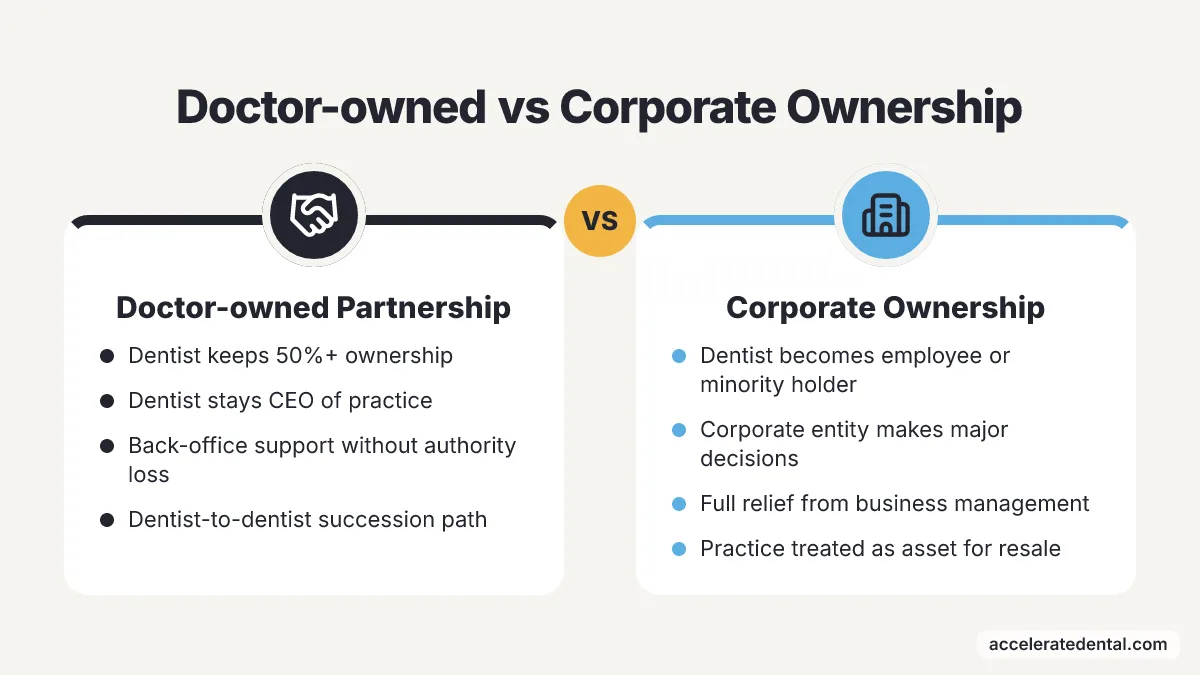
A corporate sale often changes the dentist from owner-operator into seller, employee, minority holder, or regional clinical leader, depending on the deal. Some dentists want that shift, especially when retirement is close or when the practice has grown beyond the owner's tolerance for business risk. A full sale is not automatically wrong, but it is permanent, and it deserves more scrutiny than the first offer letter usually gets.
A doctor-owned partnership keeps the dentist at the center of the operating model. At Accelerate Dental, we are a dental partnership group where dentists keep 50% or more and stay CEO of their practice. We are owned by dentists, not private equity, and we are not for sale. The difference shows up in meetings, not in slogans. A dentist who remains CEO still carries leadership responsibility, yet the owner is not left alone with the work that drains time and judgment. Back-office support in finance, HR, legal and compliance, marketing, and operations changes the owner's calendar without taking away the owner's judgment.
Insurance and fee optimization deserve special attention because payer work quietly shapes practice economics. A dentist can have full chairs and still feel pressure when coding support, billing follow-up, fee schedules, and collections reporting are inconsistent. Partnership support matters most when it turns those hidden operational leaks into visible decisions the dentist can act on. A doctor-owned model also changes the succession conversation. Corporate acquisition commonly focuses on transfer to a buyer. A dentist-to-dentist succession path focuses on continuity, with another dentist carrying the practice forward instead of treating the office as an asset to package for resale.
The honest trade-off is responsibility. A dentist who keeps majority ownership and stays CEO has not outsourced leadership. The dentist has chosen a model that removes back-office drag while preserving the authority and accountability that come with ownership.
Alternatives to corporate dental companies for dentists who want relief
Independent ownership remains the right answer for some dentists. A strong office manager, outside CPA, employment attorney, marketing vendor and billing support can keep a private practice running without joining any group. The downside is coordination, because the dentist still acts as the hub for every vendor, every report and every stalled handoff.
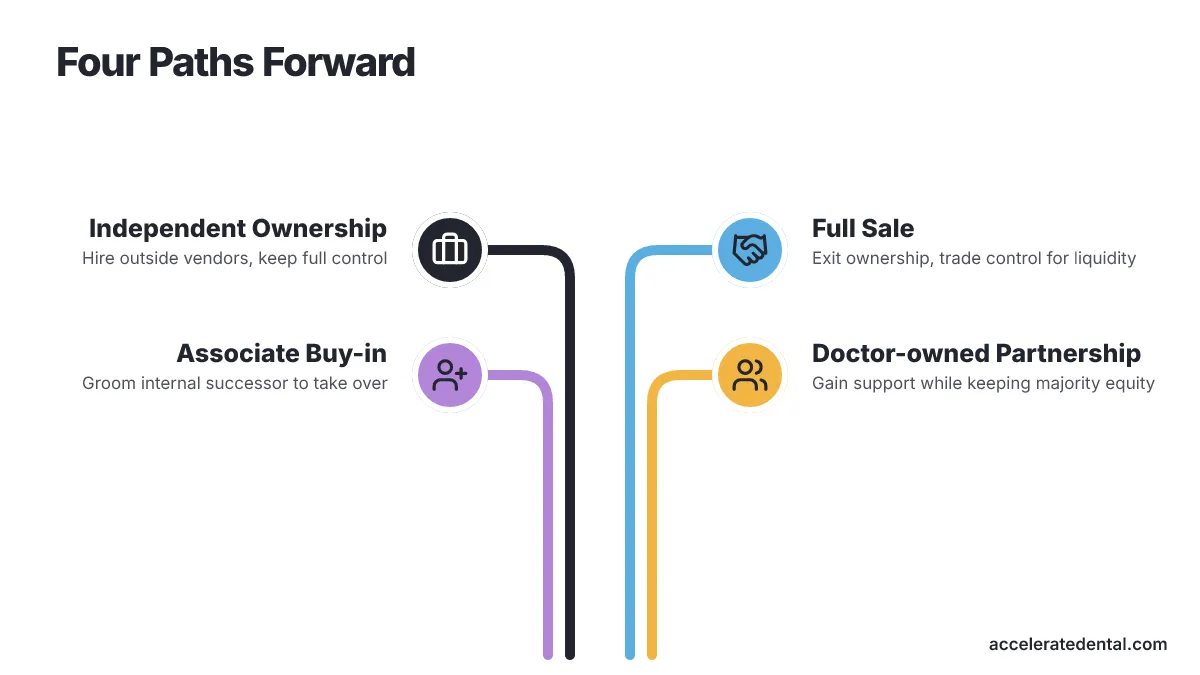
A traditional full sale is the cleanest path for a dentist who wants to exit ownership quickly. The seller trades control for liquidity and reduced management burden, then works under the terms negotiated in the purchase and employment documents. The decision becomes less attractive when the dentist still wants growth, leadership and a say in how the practice develops.
An internal associate buy-in or partner track works when the practice already has the right successor. A younger dentist who understands the culture, patients and team may be the best person to carry the office forward. The challenge is capital, training, management maturity and timing, because a clinically strong associate is not automatically ready to run payroll, compliance, payer strategy and growth planning.
A doctor-owned dental partnership is built for the owner who wants support without a corporate handoff. The model fits dentists who want to keep majority equity, stay CEO and gain the business systems that usually sit inside larger organizations. The work becomes less about selling out and more about choosing which parts of ownership should be shared.
Our partner network serves dentists in Utah, Idaho, Arizona, Colorado, Nevada, Washington and Wyoming. The geographic footprint matters because peer community and dentist-to-dentist succession work better when partnership is close enough to be relational, not just contractual.
A dentist near retirement needs a different option than a dentist trying to open the next location. Customized exit strategy and transition planning should address who will lead, how the team will be protected, and what role the selling dentist wants after the transaction. A generic sale process rarely answers those questions with the care a founder expects.
A growth-minded dentist should look for strategic growth planning and M&A support without assuming corporate ownership is the price of expansion. Growth capital and operating discipline are useful, but they should not automatically move the dentist out of the CEO seat. The better question is whether the structure funds growth while preserving the dentist's right to lead the practice.
A burned-out owner should not mistake exhaustion for readiness to sell. One partner doctor described the change this way: "What changed for me was massively reduced stress, Accelerate took a ton of that pressure off and allowed me to focus on my life." Stress relief is not the same as surrendering the practice, and dentists should separate those two decisions before they sign anything.
What should a dentist check before signing with any group?
The first thing to read is the operating agreement, not the marketing deck. A dentist needs to know who owns what, who gets a vote on what, who can push through a sale, who signs off on budgets, and what happens if the dentist wants to slow down, grow, add an associate, or step away.
A dentist should work through the deal in the same order that real life shows up:
- Sort out which decisions stay with the dentist, including clinical protocols, materials, scheduling philosophy, associate fit, and team culture.
- Check whether the dentist keeps a meaningful ownership stake and stays CEO of the practice.
- Ask who owns the partnership group, and whether private equity can force a later sale.
- Look at the support model for finance, HR, legal and compliance, marketing, operations, billing, insurance, and fee optimization.
- Ask how weekly and monthly financial reports will change the owner's decisions, not just how those reports arrive.
- Talk about succession before retirement becomes urgent, including whether another dentist can carry the practice forward.
- Speak with partner doctors who have already gone through the move and ask what changed in their week.
The second check is cultural fit. A group can have competent systems and still be wrong for a dentist who wants peer mentorship, clinical autonomy, and a long-term home. One partner doctor put the standard plainly: "I believe in a model that combines strong support, best practices, and mentorship with true clinical autonomy."
The third check is the time cost of the new model. Partnership meetings, reporting rhythms, leadership coaching, and growth planning take attention. A dentist who wants support should expect a different owner calendar, not an empty one.
The fourth check is price and structure, but the number matters only after the control terms are clear. Dentists comparing models can review our partnership pricing information when they are ready to see how the model is framed. The better order is control first, economics second, transition third. The fifth check is whether the group has a dentist-to-dentist path or only an acquisition path. A dentist who built a practice over decades usually cares who inherits trust with patients and staff. Succession planning should name the future leader, the timing, the mentoring plan, and the founder's role after the transition.
The sixth check is whether the group treats compliance as a system rather than a scramble. Team training, compliance officer certification, and HIPAA assessments protect the practice from avoidable confusion. Dentists do not need another binder on a shelf. They need a repeatable process the team will actually use.
When a corporate dental sale is the wrong answer to the right problem
Administrative burnout is the most common reason a good dentist starts listening to corporate dental companies. The dentist is worn out from handling HR problems between appointments, tired of wondering whether marketing is paying off, and tired of watching insurance work hit cash flow with no clear dashboard. The problem is real. Selling control is only one way to deal with it. A corporate sale is the wrong answer when the dentist still wants to shape the practice's future. A founder who wants to mentor associates, pick the next leader, protect team culture, and keep building value needs a model that leaves the dentist in command. A sale that fixes paperwork while taking away authority creates a different kind of frustration.
A corporate sale can be the right answer for a dentist who wants to stop being CEO and is fine with another organization making the major business decisions. That owner should not pretend to want a partnership. A clean sale may fit better than a doctor-owned model that still asks for leadership, planning, and active engagement. Accelerate's view is not anti-support, it is anti-surrender. We believe dental practice owners should be able to gain a full back-office stack, peer community, Clinical Council mentorship, and a succession path without handing the profession's future to private equity. One partner doctor's line captures the ambition: "Accelerate is the future of dentistry practice ownership."
A private practice owner should ask whether the proposed model is built to stay in place or built to trade hands. A group owned by dentists and not for sale thinks differently about succession, local leadership, and clinical autonomy than a platform built around resale. The exit path of the organization matters because it can become the exit path of the dentist whether the dentist planned it or not.
A practice owner should also ask what happens when growth creates pressure. Growth without better reporting, payer support, HR systems, and compliance discipline only gives the owner a larger version of the same burden. Growth inside a doctor-owned partnership should make decisions clearer. It should not move decisions away from the dentist.
How to choose among the options without losing the practice you built
A dentist should start by looking at the role they want five years from now. That choice reads very differently for an owner who plans to keep practicing three days a week and train a successor than for an owner who wants out cleanly. The right structure fits the future role first, before it matches today's frustration.
A dentist who wants full independence should first strengthen the vendor bench. That route means bringing in better outside support, tightening reporting, and accepting that the owner still carries the coordination load. Control stays highest, and the tradeoff is more management work.
A dentist who wants to exit ownership should compare full-sale options with care. The questions that matter are post-sale authority, employment terms, transition timing, and what actually appears in the documents. Finality comes with that path, and control goes with it.
A dentist who wants relief, growth, and continued leadership should compare doctor-owned dental partnership models. The owner should look for majority equity kept by the dentist, clinical autonomy, CEO status, back-office support, insurance and fee optimization, analytics, growth planning, and a dentist-to-dentist succession plan. Support arrives without surrender, and the price is staying active as an owner.
A dentist who wants an internal successor should begin earlier than feels comfortable. Associate development, financing, leadership training, and patient trust all take time. Continuity is the payoff, and uncertainty shows up fast if the successor is not ready when the owner is.
The decision gets clearer when the dentist writes two lists before any meetings. The first list names the work the dentist wants off the desk: payroll, HR, compliance, payer negotiations, billing follow-up, marketing, reporting, or growth planning. The second list names the authority the dentist will not hand over: clinical judgment, team culture, successor choice, patient experience, and the long-term direction of the practice.
A serious conversation with any group should begin after those lists are on paper. A dentist who knows the line between support and control can hear the difference between a corporate acquisition pitch and a real partnership offer. That clarity protects the practice before the term sheet arrives.
Conclusion
Start with the role you want to keep, not the burden you want to escape. A dentist who wants relief from management pressure should write down the decisions that must stay in the practice owner's hands, then test every option against that list. Corporate dental companies, full-sale transactions, internal succession, and doctor-owned partnerships solve different problems. The next step is a real conversation about ownership, control, support, and succession before valuation language takes over the room.
To see whether that model fits your goals, book a call and speak with one of our partner doctors.
Frequently Asked Questions
What are the main benefits of corporate dental companies?
Corporate dental companies offer relief from non-clinical tasks such as HR, insurance, and marketing. They provide a cleaner division of labor by taking over administrative functions, allowing dentists to focus more on patient care and leadership.
What are the downsides of choosing a corporate dental company?
The main downside is the potential loss of control over key decisions. Corporate ownership can change who controls capital spending, staffing models, and growth plans, which may lead to the dentist no longer having the same level of authority over their practice.
How does a doctor-owned dental partnership differ from corporate ownership?
In a doctor-owned dental partnership, dentists retain majority ownership and stay CEO of their practice. This model allows them to keep leadership responsibilities while receiving back-office support, unlike corporate ownership where the dentist may become a minority holder or employee.
What alternatives exist for dentists who want to avoid corporate dental companies?
Alternatives include maintaining independent ownership with the help of a strong office manager and external vendors, pursuing an internal associate buy-in, or joining a doctor-owned dental partnership like Accelerate Dental, which offers support without relinquishing control.
Why might a dentist choose a doctor-owned partnership like Accelerate Dental?
A dentist might choose a doctor-owned partnership like Accelerate Dental to maintain majority equity and leadership while gaining business systems support. This model reduces back-office burdens without sacrificing the dentist's authority and accountability in their practice.